

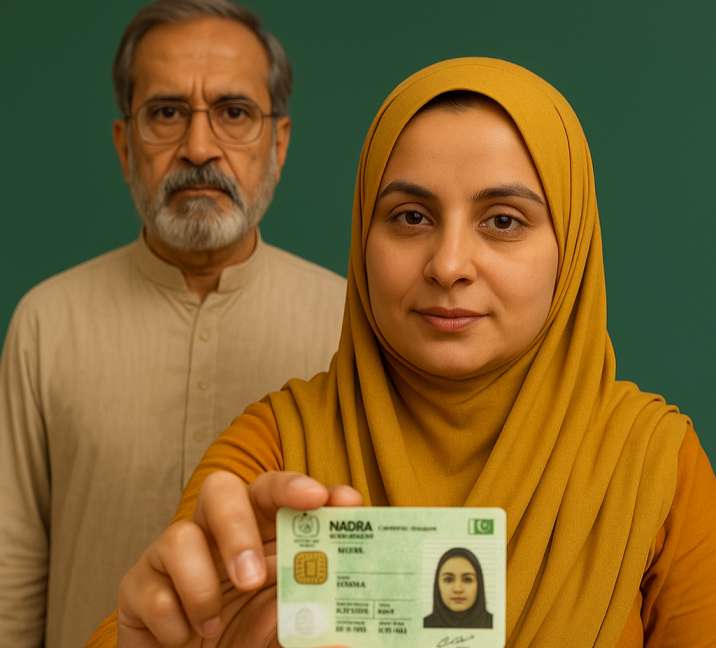
In a groundbreaking move for women’s rights and identity autonomy, the National Database and Registration Authority (NADRA) has introduced a historic policy: married women in Pakistan can now choose to retain their father’s name on their Computerized National Identity Card (CNIC) even after marriage.
This new policy marks a significant departure from the long-standing tradition where women were required to update their CNIC to display their husband’s name after marriage. The change brings long-awaited recognition to a woman’s individual identity, empowering her to make decisions about how she wishes to be represented legally.
A Step Toward Identity Autonomy for Pakistani Women
For decades, women across Pakistan have raised concerns about being compelled to update their CNICs after marriage to reflect their husband’s name — often leading to complications in financial, legal, academic, and inheritance matters. NADRA’s new rule now gives women the legal freedom to retain their birth identity.
This update is especially beneficial for women who want to maintain consistency in their educational degrees, professional records, and personal identification across various documents.
The reform is being praised widely on social media and civil rights forums as a progressive win for gender equality and documentation autonomy. It aligns Pakistan with several other countries where identity after marriage is left to personal choice.
How the New Policy Works
- Married women can now apply for or renew their CNIC while choosing to retain their father’s name instead of adopting their husband’s name.
- This option is available during new CNIC applications, updates, or renewals at any NADRA registration center or via the NADRA mobile app.
- There is no legal restriction forcing women to switch to the husband’s name on ID cards anymore.
This flexibility enhances access to services and avoids legal confusion that many women faced previously when trying to match educational certificates and previous records with their new CNIC names.
Part of NADRA’s Larger Identity System Overhaul
The policy change is part of a broader modernization initiative NADRA has launched in 2025. As part of this reform, NADRA recently opened three 24/7 National Registration Centres in Malir Cantt, Malir, and Surjani Town in Karachi. These centres aim to make identity services more accessible and efficient.
Additional reforms include:
- Biometric B-Forms are now required for children aged 3 and above, providing each child with an individual digital identity.
- Family Registration Certificates (FRCs) now hold legal value in matters of inheritance, official claims, and documentation.
- Expansion of services through the NADRA mobile app and over 1,200 union councils across Pakistan.
Women’s Voices and Public Reaction
The decision is being celebrated by activists, educators, lawyers, and working women who have long demanded the right to maintain personal identity after marriage. Many believe it is a long-overdue reform that reflects a more inclusive and respectful legal framework for Pakistani women.
On platforms like TrendNama, social discourse has highlighted how such changes in policy uplift women’s status in society and recognize their legal individuality beyond marital status.
Moreover, the policy will ease complications in:
- Inheritance and legal disputes where name mismatches were previously problematic.
- Bank accounts and property documentation requiring father’s name for identity verification.
- Passport or visa applications where CNIC and academic records were inconsistent.
Digital Access and NADRA App
NADRA’s mobile app has also been updated to reflect these changes, allowing women to initiate updates to their CNIC profiles while choosing between father’s or husband’s name. This eliminates the need to physically visit NADRA offices in many cases.
As more services become available online, such as CNIC renewal, family registration, and biometric verification, Pakistan is stepping closer to a fully digitized civil registry.
Future Plans and Rollout
NADRA has announced plans to extend the 24/7 registration centre model to other cities including Lahore, Islamabad, and Peshawar. The new women-centric policy will be universally available throughout Pakistan.
Officials have confirmed that no additional charges will apply for choosing to retain a father’s name during CNIC issuance or renewal. It remains a matter of personal choice.
For Related Updates:
- Imad Wasim and Sannia’s separation – how public identity impacts personal choices
- How to Check Your Matric Result 2025 – Lahore Board
- Best Informative YouTube Channels in Pakistan to Follow in 2025
Conclusion
NADRA’s new CNIC policy giving married women the right to retain their father’s name represents a historic victory for personal freedom and women’s dignity in Pakistan. As part of a larger reform aimed at making identity services more inclusive, accessible, and legally empowering, this change is expected to have a lasting impact on how women in Pakistan are recognized — not just legally, but socially and culturally.
For continuous coverage on Pakistan’s tech, identity, and social reforms, stay connected with TrendNama.com.
